
The Importance of Earnings for Long-Term Portfolios


|
As the corporate earnings season ramps up, markets are shifting their focus from geopolitical concerns to tangible evidence of how businesses are performing. With the stock market hovering near all-time highs, questions around valuations and the sustainability of recent profitability trends have become increasingly important. While it's still early in the reporting season, current Wall Street forecasts suggest companies finished 2025 with healthy growth, leading the S&P 500 earnings-per-share to reach a new record level. In many ways, earnings announcements are like report cards that provide information about how companies are performing and whether their strategies are working. Professional investors scrutinize these reports because they include important figures used to value companies, which in turn affect their stock and bond prices. For long-term investors, strong earnings growth has been the main driver of stock market returns, resulting in long-term wealth creation for investors. However, the details of any single company's results matter far less than how earnings trends impact overall portfolios. What truly matters is understanding what corporate profitability says about economic growth, consumer spending, business investment, and the sustainability of the current market environment. What should investors focus on as new earnings are announced? Strong earnings growth supports portfolios
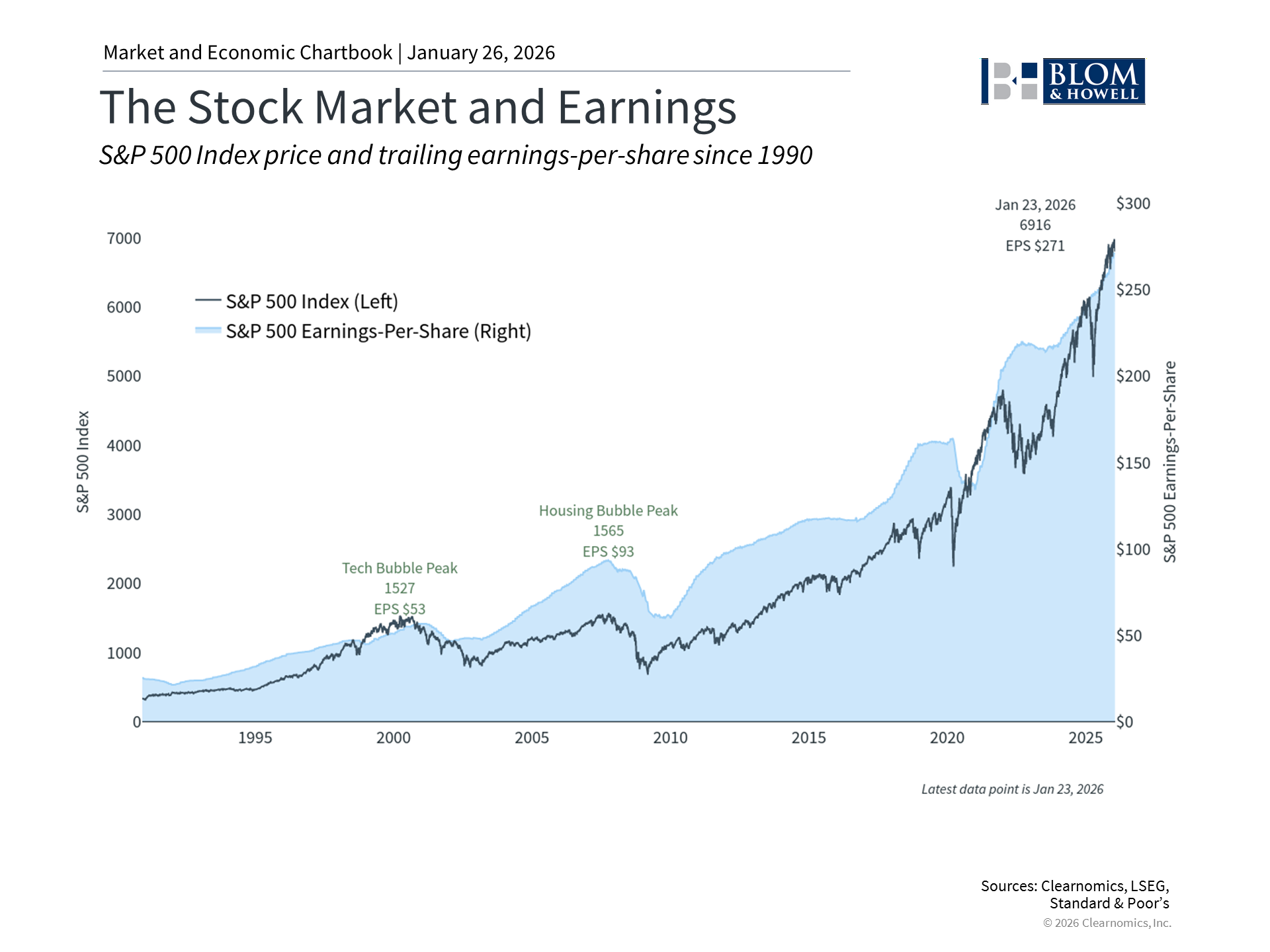
Corporate earnings are what connect the stock market to the economy, and ultimately to portfolios. When economists analyze GDP growth, the job market, or consumer spending, these factors affect investors through their impact on corporate profits. This is because a healthy economy usually leads to improved sales and earnings for companies, just as we have experienced over the past few years. Since owning stock entitles investors to a share of a company's profits, share prices tend to appreciate when earnings grow. This is not only true for the stocks of individual companies, but for the stock market as a whole. The accompanying chart shows that the stock market tends to follow the path of earnings over long periods of time. The fact that the U.S. economy is vibrant and has grown steadily is perhaps the most important reason for the long-term rise of the stock market. In the first week, about 13% of S&P 500 companies reported their results for the fourth quarter of 2025, and 75% beat earnings expectations, according to FactSet data.1 The consensus is that earnings-per-share could grow by 8.2% across S&P 500 companies, which would represent the 10th consecutive quarter of earnings growth. When looking at 2025 as a whole, LSEG figures suggest that earnings grew by 13% and could grow by around 15% in 2026 and 2027. These are well above the historical average growth rate of 7.7%. If these trends continue, they would represent healthy growth rates that support portfolios. Valuations can improve when earnings grow
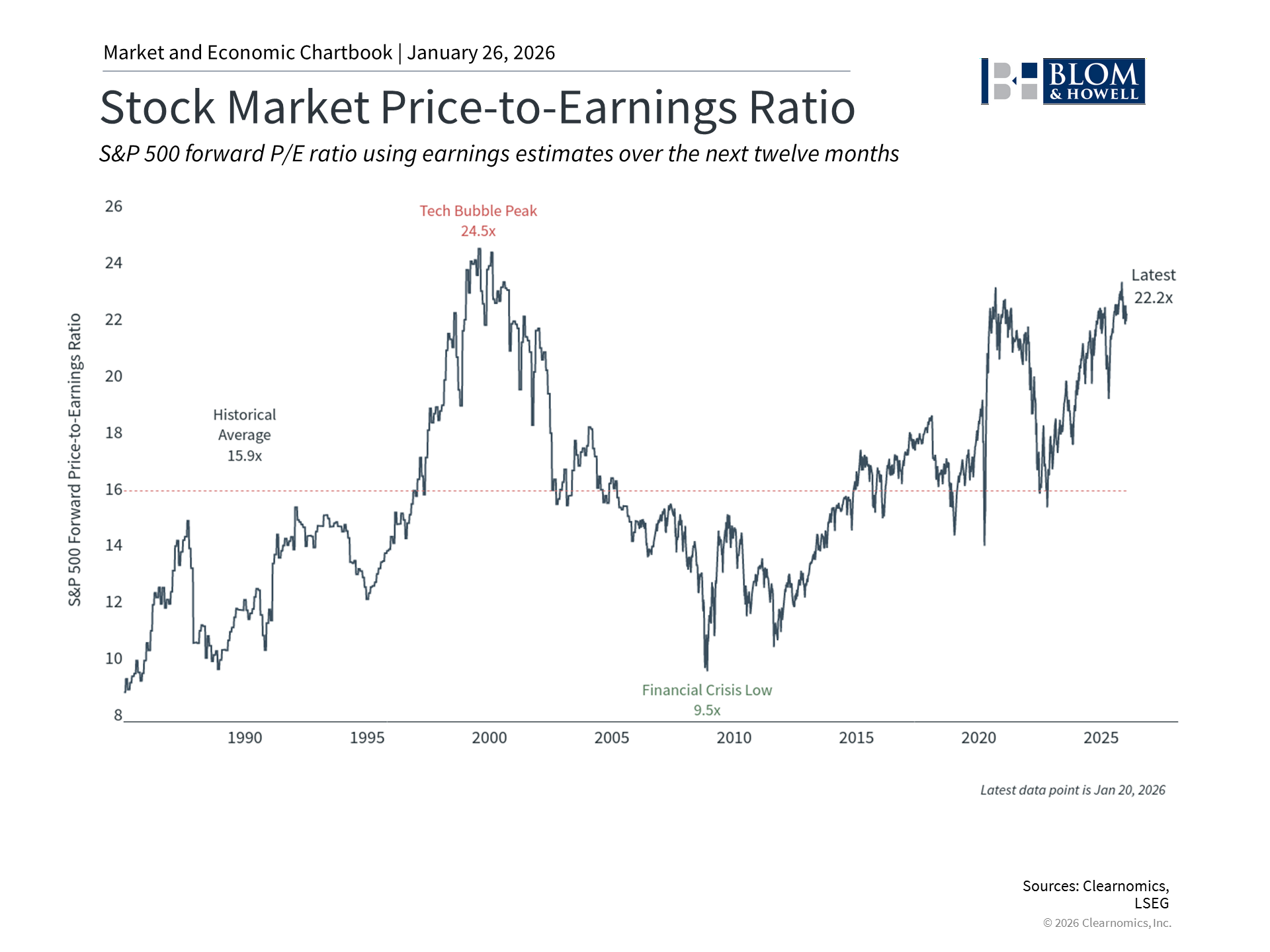
The earnings season also matters because it sheds light on stock market valuations. If earnings are the long-term driver of stock market returns, then valuations can help explain whether share prices are under- or over-valued in the short run. In other words, valuations are the gap between share prices and underlying fundamental measures such as earnings. For instance, the price-to-earnings ratio tells us how much investors are willing to pay for each dollar of corporate earnings. Today, the price-to-earnings ratio for the S&P 500 stands at 22.2x, well above the historical average of 15.9x and not far from the dot-com bubble peak of 24.5x. While this is high, it is backed by healthy earnings growth, unlike during periods such as the dot-com boom when investors ignored profitability. Understanding this connection helps put short-term market movements into perspective. When markets experience volatility, it’s often the case that earnings expectations don’t change. Instead, only prices, and thus valuations, are affected. This is why markets can often rebound quickly from short-term pullbacks if the underlying trends are unaffected. This is also why staying invested, or even investing more, during pullbacks can be helpful since this is when valuations are their most attractive. Another way to understand earnings and valuations is to calculate how much they each contributed to stock market returns in 2025. The price of the S&P 500 index rose 16.4% last year, so if earnings-per-share did grow 13% over the full year, then it was by far the largest driver of growth. Specifically, earnings contributed to 80% of the price return whereas the increase in valuations contributed about 20%. For long-term investors, this means that portfolios have done well primarily because companies have performed better, and not only because investors have been willing to pay more for stocks. That said, high valuations carry an important implication even if earnings growth remains strong. When stock prices reflect optimistic expectations about future earnings, there is often less margin for error, leading to larger market swings during periods of uncertainty. This is not a reason to avoid stocks, but instead highlights the importance of managing risk in portfolios. AI investment continues driving capital spending
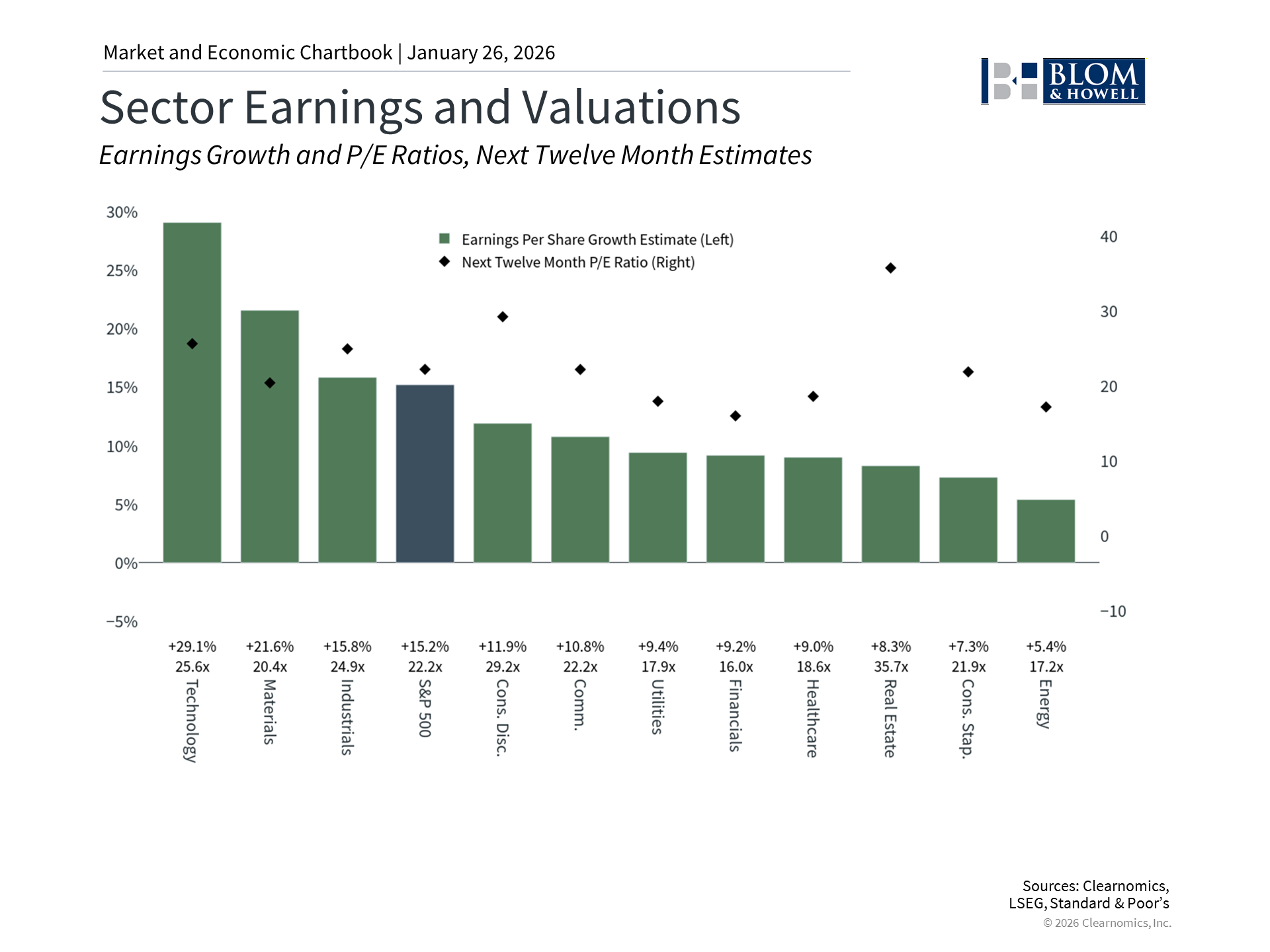
While backward-looking earnings results matter, the stock market determines prices by looking forward. Thus, guidance from company executives often drives market reactions, especially when it comes to important trends such as AI spending. Companies are investing heavily in the infrastructure needed to support AI applications, from data centers to computing hardware. This massive capital investment is reshaping not just the technology sector, but the broader economy as well. For investors, this trend has multiple implications. Companies making these investments, often called “hyperscalers” due to their massive computing infrastructure, are betting on continued growth in AI adoption. If these bets pay off through increased demand for AI services and applications, the investments could drive substantial earnings growth for years to come. However, if adoption disappoints or takes longer than expected, companies may face pressure on profit margins and returns on invested capital. The chart above shows that earnings growth expectations vary across sectors, with the highest earnings growth expectations in the Information Technology sector. While quarterly results are important, the full impact of AI on productivity and economic growth will take years to materialize. Patient investors who maintain long-term focus are better positioned to benefit from these trends than those who chase short-term performance or overreact to individual earnings reports. The bottom line? Strong corporate earnings have helped to support the stock market. With ongoing uncertainty and high valuations, investors should continue to focus on balancing their portfolios to manage risk while staying on track to achieve financial goals. References 1. https://advantage.factset.com/hubfs/Website/Resources%20Section/Research%20Desk/Earnings%20Insight/EarningsInsight_012326.pdf |
|||
|
Investment advisory services are provided by Blom & Howell Financial Planning, Inc. Copyright (c) 2026 Clearnomics, Inc. All rights reserved. The information contained herein has been obtained from sources believed to be reliable, but is not necessarily complete and its accuracy cannot be guaranteed. No representation or warranty, express or implied, is made as to the fairness, accuracy, completeness, or correctness of the information and opinions contained herein. The views and the other information provided are subject to change without notice. All reports posted on or via www.clearnomics.com or any affiliated websites, applications, or services are issued without regard to the specific investment objectives, financial situation, or particular needs of any specific recipient and are not to be construed as a solicitation or an offer to buy or sell any securities or related financial instruments. Past performance is not necessarily a guide to future results. Company fundamentals and earnings may be mentioned occasionally, but should not be construed as a recommendation to buy, sell, or hold the company's stock. Predictions, forecasts, and estimates for any and all markets should not be construed as recommendations to buy, sell, or hold any security--including mutual funds, futures contracts, and exchange traded funds, or any similar instruments. The text, images, and other materials contained or displayed in this report are proprietary to Clearnomics, Inc. and constitute valuable intellectual property. All unauthorized reproduction or other use of material from Clearnomics, Inc. shall be deemed willful infringement(s) of this copyright and other proprietary and intellectual property rights, including but not limited to, rights of privacy. Clearnomics, Inc. expressly reserves all rights in connection with its intellectual property, including without limitation the right to block the transfer of its products and services and/or to track usage thereof, through electronic tracking technology, and all other lawful means, now known or hereafter devised. Clearnomics, Inc. reserves the right, without further notice, to pursue to the fullest extent allowed by the law any and all criminal and civil remedies for the violation of its rights.

|
Posts you may like

Beyond the Headlines: Fed Rate Hikes and Long-Term Portfolios

Tariff Refunds and the National Debt: What They Mean for Investors


